
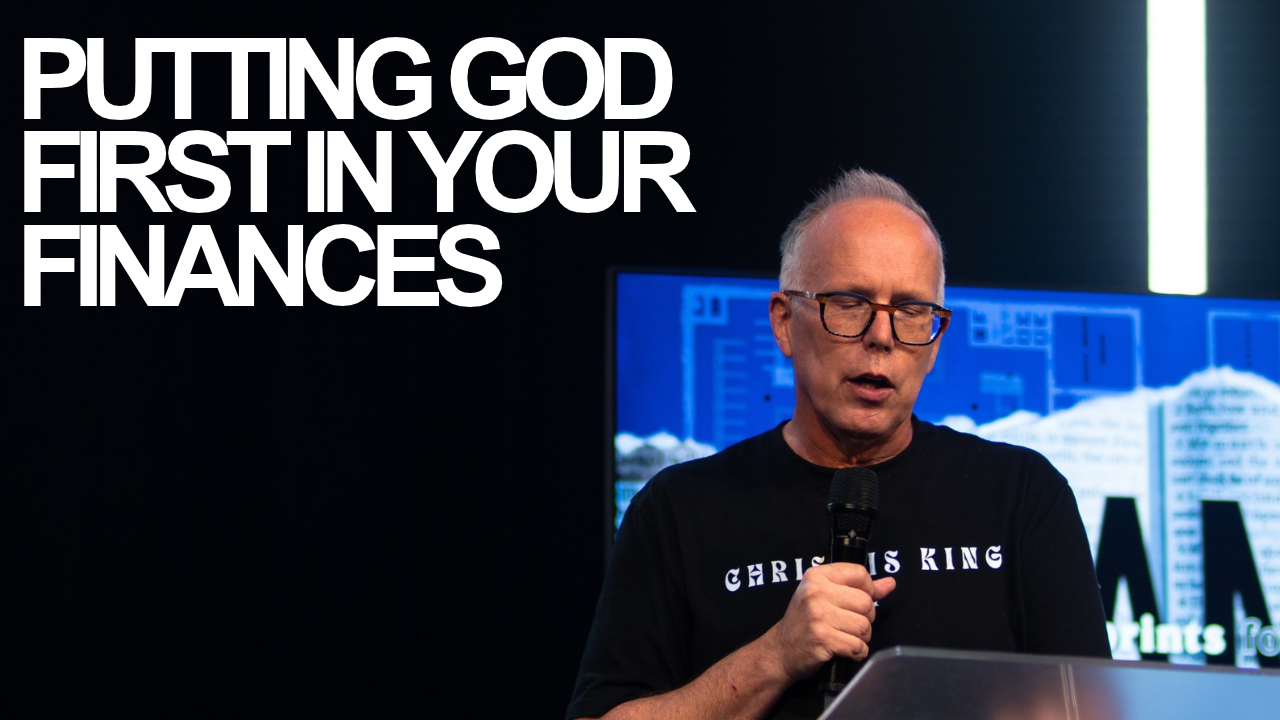
Putting God First in Your Finances
What goes first in our lives often reveals what matters most to us.
Think about how we treat our phones. We charge them overnight, keep cords in our cars, carry power banks, and make plans to ensure we never run out of battery.
We do these things because keeping our phones charged matters to us.
And what matters to us finds its way into our priorities.
As we conclude our Balanced: Foundational Blueprints for a Strained World series, Pastor Craig Millar invited us to examine what our financial priorities reveal about our hearts.
Throughout this series, we've explored three laws of balance: having a clear reference point, establishing a clear objective, and making constant corrections.
We've talked about tracking our spending, managing debt, practising contentment, and making wise financial decisions.
But this final message goes beyond dollars and cents.
It asks a deeper question:
Is God first in our finances, or does He get what's left?
What Do We Believe Gives Us Life?
In Luke 12:15, Jesus warns us to guard against greed because life does not consist in an abundance of possessions.
That statement reveals something important.
Jesus knew that money was never just about money. It was about what we trust, what we value, and where we believe life is found.
Our culture encourages us to spend first, repay debt, save whatever remains, and give if there's anything left.
But that order does more than organize our finances.
The order matters because the order forms us.
Over time, our financial habits shape our hearts, our priorities, and our relationship with God.
Jesus invites us to examine those priorities through three powerful biblical examples.
1. The Rich Fool: When Possessions Become Our Security
In Luke 12, Jesus tells the story of a wealthy farmer who experienced an abundant harvest.
His fields produced more than he could store, so he decided to build bigger barns and secure his future.
At first glance, nothing seems wrong with this.
The problem wasn't his wealth, his success, or even his planning.
The problem was that God never entered the conversation.
The man assumed that more possessions meant more life. His abundance had become the source of his security.
He never stopped to ask, God, what do You want me to do with what You have given me?
Jesus reminds us that we can accumulate possessions without becoming rich toward God.
The question isn't simply how much we have.
It's what place those things hold in our hearts.
2. Haggai: When God's Priorities Come Last
In Haggai 1, God's people had returned from exile and were instructed to rebuild the temple.
But years passed, and while they built their own homes and established their routines, God's house remained unfinished.
Their personal priorities had gradually crowded out what God had called them to do.
Through the prophet Haggai, God called them to consider their ways.
They were working hard, earning money, and pursuing their goals, yet still experiencing frustration and dissatisfaction.
It's a picture that can feel surprisingly familiar.
We work longer hours, pursue new opportunities, upgrade our possessions, and try to build a comfortable life.
Yet sometimes, despite all that effort, something still feels missing.
The warning isn't against hard work or enjoying what God provides.
It's against building a life while neglecting the One who gives life its meaning.
God calls us to examine our priorities and consider where our current direction is taking us.
3. The Widow: When Giving Becomes an Act of Trust
In Luke 21, Jesus notices a poor widow placing two small coins into the temple treasury.
Others gave larger amounts from their abundance.
But the widow gave from what little she had.
Jesus drew attention to her offering because its significance wasn't found in the amount.
It was found in her trust.
Her giving reflected a heart that believed God was her source.
And that's the invitation for us.
Giving is not merely a financial transaction. It is an act of worship that expresses our trust in God.
Give, Save, Live
So what does putting God first look like practically?
Pastor Craig introduced a simple adjustment to the way we approach our finances:
Give first. Save second. Live on what remains.
Rather than following the cultural pattern of spending first and giving whatever is left, we can intentionally place generosity at the beginning.
This is where percentage giving becomes a practical tool.
Throughout Scripture, we see examples of people responding to God's provision through intentional giving.
In Genesis 14, Abraham gave a tenth after God delivered him from his enemies. His response acknowledged that God was his protector and provider.
At Horizon Church, we believe tithing is an important training ground for developing a lifestyle of generosity.
But Jesus makes it clear that giving is about more than getting the percentage right.
In Matthew 23, He confronted those who were careful about tithing but neglected justice, mercy, and faithfulness.
God is interested in our hearts.
The purpose of giving isn't simply to follow a formula.
It's to declare that Jesus, not money, is our master.
Don't Despise Small Beginnings
For some, the idea of rearranging an entire financial life can feel overwhelming.
Perhaps debt feels impossible to overcome. Perhaps your income barely covers your responsibilities. Perhaps you've been living with the same habits for years.
But Scripture offers encouragement.
In Zechariah 4, God reminds His people that what seems impossible will not be accomplished by human strength alone, but by His Spirit.
And then comes a powerful reminder:
Do not despise the day of small things.
Financial freedom rarely happens through one enormous decision.
It grows through small, faithful steps repeated over time.
One adjustment.
One act of obedience.
One decision to trust.
One choice to put God first.
Depending on God's Spirit doesn't mean there is no work for us to do.
It means we take the steps He's calling us to take while trusting Him for the strength and grace to keep moving.
Your Challenge This Week: Make a Small Shift
As we conclude this series, Pastor Craig encouraged us to take three practical steps.
First, calculate what percentage of your income you gave last year.
Not simply the total amount, but the percentage in relation to what you earned.
Second, prayerfully choose what you will give in the coming year.
Consider what intentional generosity could look like in your current season.
Third, rearrange your financial life accordingly.
Begin building generosity into your priorities instead of leaving it until the end.
The goal isn't to place more pressure on ourselves.
The goal is to discover the freedom that comes from putting God first.
Freedom to respond when He speaks.
Freedom to live generously.
Freedom from fear and greed.
Freedom to enjoy what He has provided.
Freedom to trust Him in every area of life.
Because our lives are not found in the abundance of our possessions.
Our lives are found in Jesus.
Looking back over the Balanced series, what has been the most significant thing God has challenged or taught you?
Pastor Craig said, “What goes first in our lives often reveals what matters most.” How does this apply to the way we handle our money?
In the parable of the rich fool, the man's mistake wasn't having wealth but failing to include God in his decisions. How can we recognize when possessions are becoming our source of security?
What can we learn from the people in Haggai's day about allowing our personal priorities to crowd out God's purposes?
Why do you think Jesus drew attention to the widow's small offering rather than the larger amounts given by others?
What does it mean to make giving an act of worship rather than simply a financial obligation?
How could changing our financial priorities to “Give, Save, Live” shape our hearts and our relationship with God?
Why is it important to remember that generosity is about trust, not simply percentages?
The sermon encouraged us not to despise small beginnings. What is one area where you need to trust God's grace for gradual progress?
What is one practical adjustment you believe Jesus is inviting you to make as we conclude this series?